Spodumene Processing
Ponds and DLE start with lithium that is already dissolved, and their job is to concentrate it. The rock route has a harder first job: it has to pull lithium out of a silicate crystal that has held it for hundreds of millions of years. That takes a kiln, an acid roast and a few weeks, where a pond train needs years.
Where This Page Starts
It starts at the pit rim, with pegmatite ore already drilled and blasted. The geology behind that rock is covered in Hard Rock. What matters here is chemistry: in a salar the lithium is a free ion in water, while in spodumene it is locked inside a rigid lattice of aluminium and silicon. Evaporation and sorbents can't release it. Heat and acid have to.
That difference is why this flowsheet is fast but uses a lot of energy, and why an evaporation pond is the reverse: nearly free to run, but slow.
Four Steps from Ore to Lithium Solution
Each step below does one job. Steps 3 and 4 are the ones that release the lithium.
Pegmatite ore is drilled, blasted and hauled; most spodumene mines are open pits. The rock is then crushed and milled to free the spodumene crystals from the quartz, feldspar and mica around them. If the grind is too coarse, crystals stay locked in the rock. If it is too fine, the next step can't recover them.
Dense media separation uses the fact that spodumene is heavier than the minerals around it, and froth flotation recovers the finer fraction. Magnetic separation removes iron-bearing particles, which buyers penalise. The output is spodumene concentrate, the product that is shipped and traded.
The concentrate is fired in a rotary kiln. Spodumene changes from the monoclinic α form to the tetragonal β form and expands by about 30% in volume. α-spodumene barely reacts with acid and β-spodumene does, so the rest of the process depends on this step.
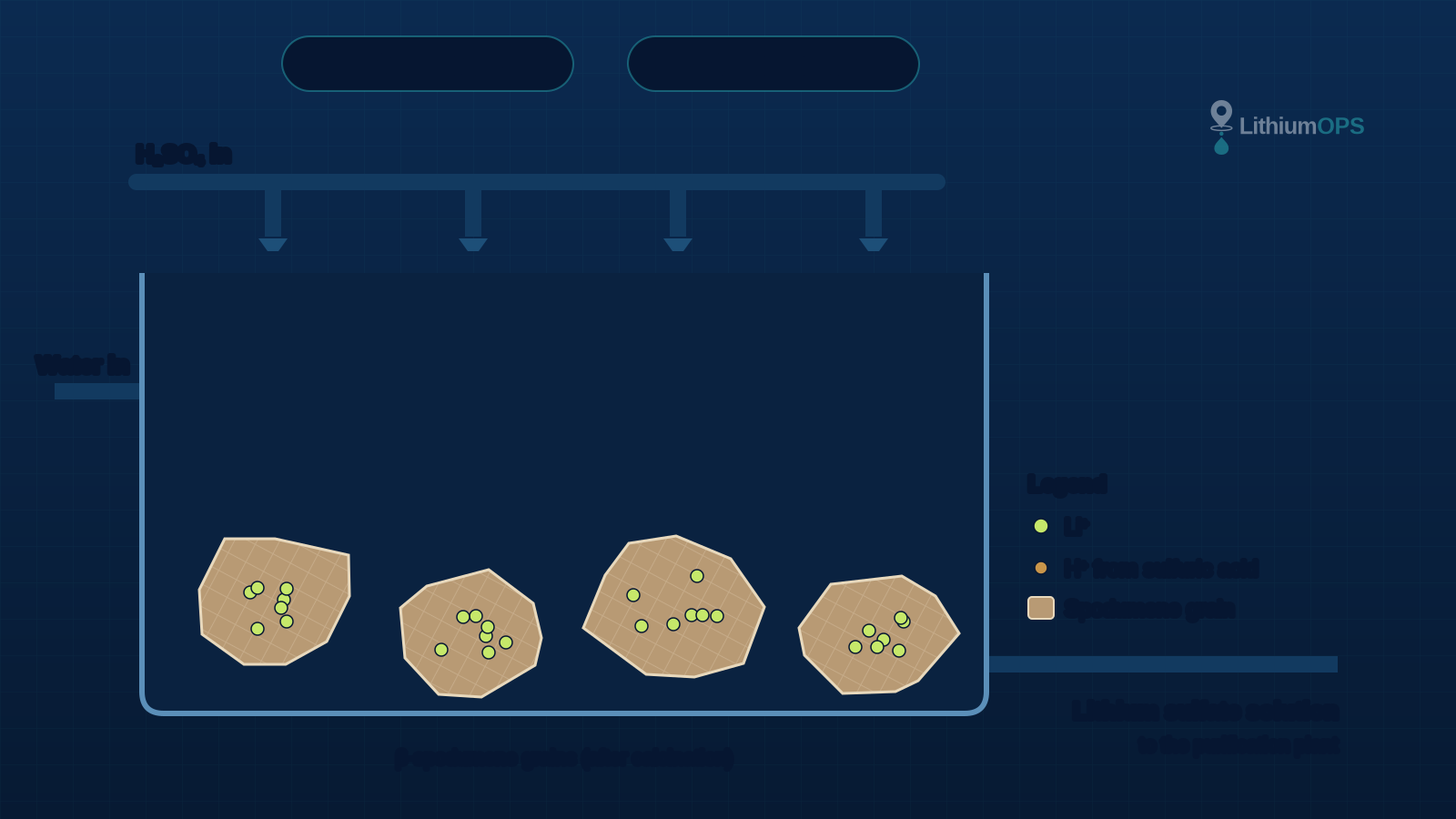
β-spodumene is mixed with concentrated sulfuric acid and roasted. Hydrogen ions from the acid take the place of lithium in the crystal, and the lithium becomes lithium sulfate. Lithium sulfate dissolves in water, so a water leach carries it into solution and leaves the spent silicate behind as residue. From here on the lithium is in a liquid, as it is on the brine route.
Why SC6 Is the Number Everyone Quotes
Step 2 does not produce lithium. It produces a concentrate, and that concentrate is what gets bought and sold. It trades as SC6, material graded at 6% Li₂O, and it is the reference product in price reports. Converting it to lithium carbonate equivalent (LCE) works like this:
That 6.7 is a floor, not a real-world ratio. It assumes no lithium is lost between the kiln and the final crystalliser, and some always is. The ratios converters publish are higher and vary with the plant, the feed grade and the flowsheet, so each converter's own figure is worth reading instead of assuming a fixed number.
Where the Two Routes Meet
After the leach, the plant holds a strong but unpurified lithium sulfate solution that also carries iron, aluminium, magnesium and calcium. Ponds and DLE reach a similar point by a different road: a concentrated liquor with its impurities still in it. From there the flowsheets look alike: impurity precipitation, ion exchange polishing, and carbonation with soda ash to precipitate lithium carbonate.
Crush, concentrate, calcine, acid roast, leach. It takes weeks, uses a lot of energy, works in any climate and moves a lot of waste rock.
Pump brine and evaporate it through a pond train for up to 36 months. It uses almost no energy, but it needs a desert and time.
Capture lithium from brine on a resin, sorbent or membrane in hours. It is faster than ponds and uses less land, but it is the newest of the three at commercial scale.
The purification step all three feed into is covered in Lithium Carbonate Production. Where the routes differ is the point at which each one can branch toward its final salt.
Carbonate or Hydroxide: Where Each Route Branches
Two products make up most of the market: lithium carbonate (Li₂CO₃, quoted as LC) and lithium hydroxide monohydrate (LiOH·H₂O, quoted as LHM). The deposit does not decide which one a plant makes, because both routes can reach both salts. What changes is where the route branches, and that follows from the chemistry each route starts with.
From spodumene, hydroxide is a direct product. The acid roast leaves the lithium as a sulfate in solution, and once that liquor is purified it can go either way: add soda ash and Li₂CO₃ precipitates, or add caustic soda and crystallise LiOH·H₂O without making carbonate first. That shortcut is why much of the battery-grade hydroxide capacity has been built around spodumene feed.
From brine, both products are possible too. Pond and DLE liquors arrive as chlorides, not sulfates. The usual path turns them into carbonate with soda ash and makes hydroxide in a second step: the carbonate reacts with lime, insoluble calcium carbonate drops out, and LiOH stays in solution to be crystallised as LHM. Some producers also take purified brine liquor to hydroxide more directly, through electrochemical or ion-exchange routes. So a brine operation can choose LC or LHM, and carbonate works well as an intermediate on the way to hydroxide.
Whatever the route, the crystal that leaves the plant is the same monohydrate. Its variants come from finishing, not from the route. Anhydrous LiOH is the monohydrate with its water driven off, and battery grades differ in particle size and in limits on residual carbonate, sulfate and magnetic content. The cathode maker's specification sets those limits, whether the lithium came from a rock or a salar. Where those specifications come from is covered in From Lithium Chemicals to Cathodes.