Evaporation Pond Systems
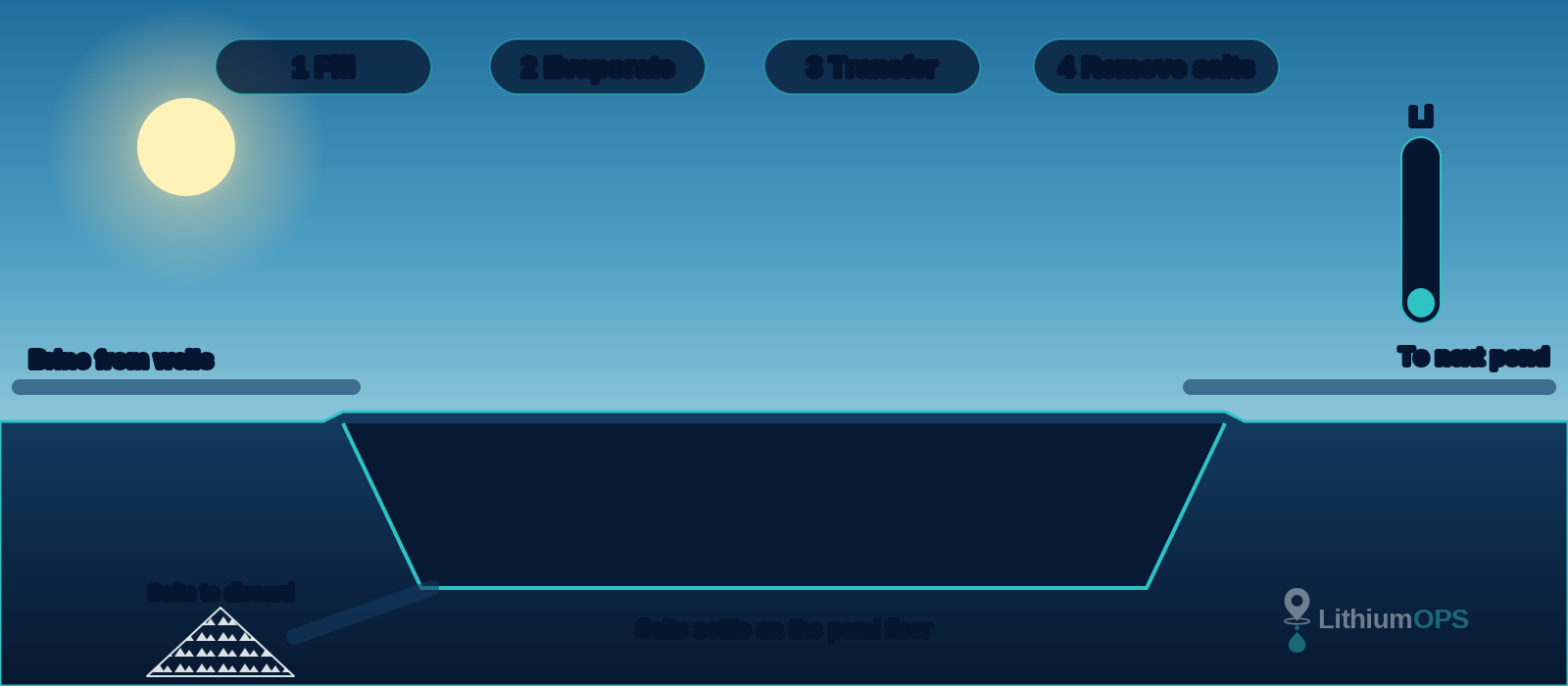
Evaporation ponds use the sun to concentrate lithium. Brine is pumped from the ground and moved through a series of ponds for up to 36 months until lithium reaches concentrations high enough for chemical processing.
How It Works — The Basic Principle
Solar evaporation exploits a simple thermodynamic fact: lithium chloride is one of the most soluble salts in nature. As water evaporates from a shallow pond, other less-soluble salts (NaCl, K₂SO₄, MgSO₄) crystallise out first, leaving lithium behind in an ever-more-concentrated solution.
The Atacama Desert is ideal for this process: it receives less than 1 mm of rainfall per year while solar radiation drives 3,500–4,000 mm of evaporation annually — one of the highest evaporation-to-rainfall ratios on Earth.
A single pond can cover up to about 1 million m². How far the brine is concentrated depends on the process and on the chemistry of each brine: at the Salar de Atacama it enters at around 0.2% lithium and leaves the ponds at close to 6% lithium, ready for the chemical plant.
The Four Stages of Concentration
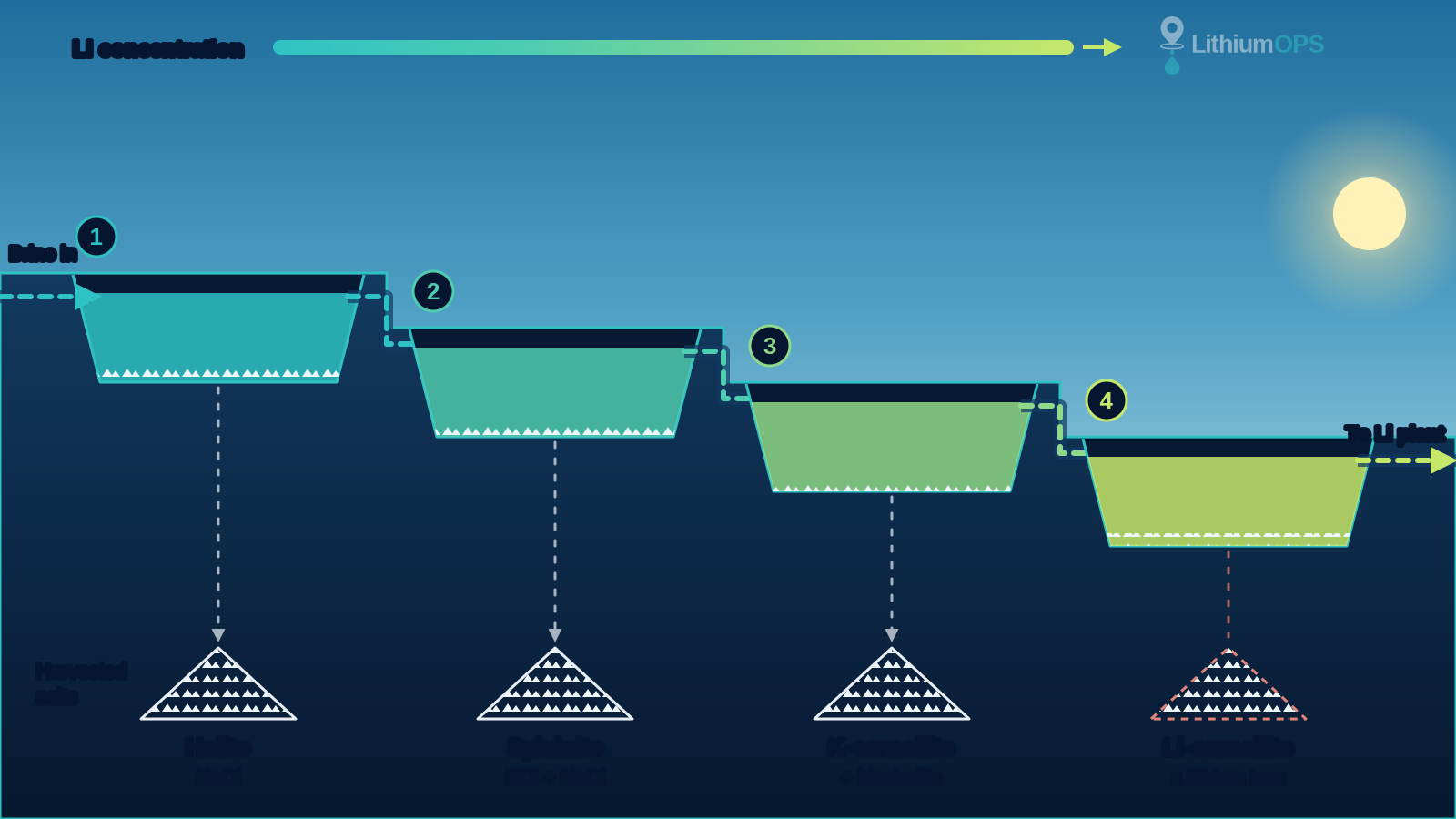
Each stage in the pond system is designed to precipitate a specific mineral out of solution. The colour shift visible from satellite imagery — from turquoise to lime green — follows the chemical composition of the brine at each stage.
Brine pumped from the aquifer enters the first ponds. As water evaporates, sodium chloride (halite) crystallises and settles on the pond floor. The brine is turquoise.
Once the brine is saturated in potassium, sylvinite — a mix of potassium chloride (KCl) and halite — precipitates. It is harvested and sent to a plant that separates the KCl, sold as potash fertiliser. Which salts appear here depends on the composition of each brine: sulphate-rich brines, for example, also drop sulphate salts.
As magnesium builds up, potassium carnallite (KCl·MgCl₂·6H₂O) precipitates, followed by bischofite (MgCl₂·6H₂O). Harvesting them strips most of the magnesium and the remaining potassium out of the brine.
In the last ponds lithium carnallite (LiCl·MgCl₂·7H₂O) can precipitate. That salt is lithium lost, so operators control the transfer to stop before the brine reaches that point. The lime-green concentrate then goes to the lithium carbonate plant.
Water & Environmental Considerations
The primary environmental concern with evaporation pond operations is water consumption. Brine extracted from the salar is ancient water that took thousands of years to accumulate. Over-extraction can lower the water table, affect nearby wetlands (vegas and lagunas), and impact the flamingo populations that depend on these ecosystems.
Modern operations must submit detailed hydrogeological impact assessments and comply with extraction quotas set by national regulators. In Chile, CORFO sets the extraction quotas for the Salar de Atacama.
Limitations of Evaporation Ponds
Despite being low-cost, solar evaporation has real limitations that are driving investment in Direct Lithium Extraction (DLE):
Production lead time is long. Prices can move dramatically before lithium reaches the market.
Rain events dilute ponds and reset the concentration process. El Niño years can delay output by months.
Only works at extremely arid locations. Cannot be deployed in wet climates (Canada, USA, China, Europe).
Only 40–60% of the lithium in the brine is actually recovered. The rest is lost in tailings.