Hard Rock & Spodumene
The other half of the lithium industry, and a completely different rock. Where a salar holds lithium dissolved in water, hard-rock deposits lock it inside a crystal — grown in the last drops of a granitic magma, hundreds of millions of years ago, in places that owe nothing to today's climate.
The Minerals That Carry Lithium
Almost all hard-rock lithium comes from spodumene (LiAlSi₂O₆), a lithium-aluminium silicate. As everywhere in the industry, its lithium content is given as Li₂O (lithium oxide): spodumene crystals from producing mines assay around 6–7.5% Li₂O, which is about 2.8–3.5% lithium. The table gives the same figure for each mineral: how much Li₂O the mineral itself contains, not how much of the mineral there is in the rock. The values are those reported from mined material, which fall below what each chemical formula allows because natural crystals carry substitutions and inclusions. Which mineral a deposit carries decides who buys it: batteries want spodumene, while glass and ceramics have used petalite and lepidolite for decades.
Those are figures for the mineral, not for the rock. What comes out of the ground is a mixture of the lithium mineral and barren quartz, feldspar and mica, so the ore grade is an order of magnitude lower: most operating pegmatite mines work ore of around 1.0 – 1.5% Li₂O, with Greenbushes an outlier well above 2%. Cut-off grades of roughly 0.5 – 0.7% Li₂O are common.
How an LCT Pegmatite Forms
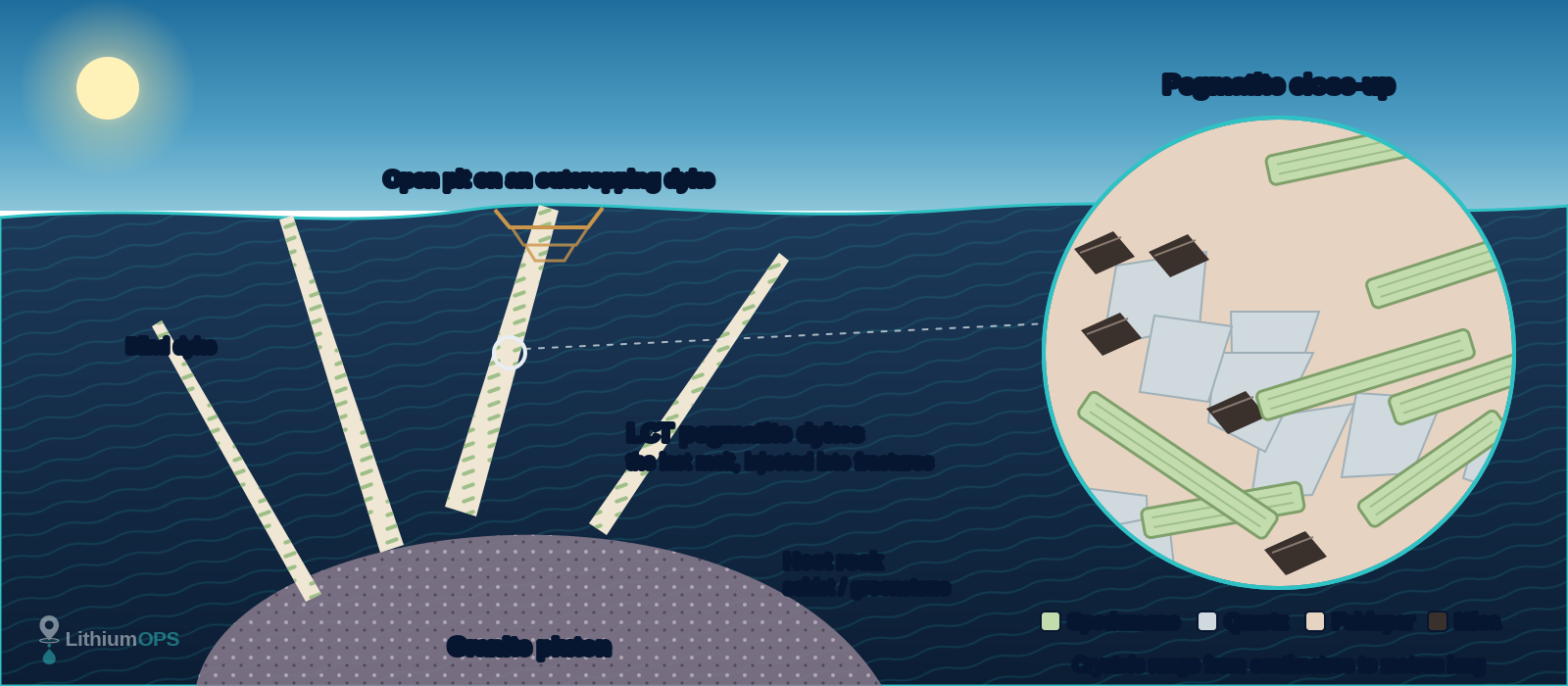
Spodumene forms in LCT pegmatites — coarse-grained igneous bodies named for the lithium, caesium and tantalum they concentrate. They are the last fraction of a granitic magma to crystallise: as the melt cools, ordinary rock-forming minerals take the elements that fit their crystal structures, and lithium does not fit. Its ion is too small and too poorly charged to substitute comfortably, so it stays behind in the shrinking residual melt, becoming more concentrated with every mineral that crystallises out.
That residual melt is also rich in water, fluorine, boron and phosphorus. Those elements make it runny and slow to nucleate, which is why pegmatite crystals are famously large: few crystals start, and each one grows enormous. The melt is injected into fractures in the surrounding rock, where it cools as a dyke or a lens, typically zoned — a fine-grained margin, an intermediate zone where the spodumene concentrates, and a barren quartz core.
Most of the world's significant LCT pegmatites are Archean or Proterozoic, emplaced in old cratons and the orogenic belts stitched onto them. That age is the reason the map below looks the way it does: the deposits sit where ancient continental crust survives at surface, not where the climate happens to be dry.
Where the Pegmatites Are
Because the process is geological rather than climatic, these deposits are not restricted to deserts. They occur in rainforest, in temperate farmland and under snow — climates where an evaporation pond would never work.
The largest source of mined lithium in the world. Greenbushes sits in a Precambrian shear zone and is the highest-grade spodumene deposit in production; Pilgangoora, Mt Marion and Wodgina lie in the Pilbara craton.
The Bikita pegmatite has been worked for lithium minerals since the 1950s, historically for petalite. Arcadia, near Harare, is the newer spodumene operation.
The Araçuaí–Itinga pegmatite district, in a Neoproterozoic orogenic belt, hosts a dense cluster of spodumene bodies close to existing infrastructure.
Two different rocks: coarse spodumene pegmatites on the Tibetan margin in Sichuan, and lithium-bearing mica (lepidolite) in the granites around Yichun, Jiangxi.
Archean greenstone belts of the Canadian Shield. The Tanco pegmatite in Manitoba is the textbook example of a strongly zoned LCT body.
Goulamina in Mali and Ewoyaa in Ghana sit in West African cratonic terrain; Portugal works lepidolite pegmatites that long fed the ceramics industry rather than batteries.
Lithium Clays
Lithium also occurs in clays. These are sedimentary deposits, not pegmatites: fine-grained claystones laid down in old volcanic lake basins, where lithium released from volcanic glass was taken up by clay minerals such as hectorite-type smectite and illite. There are no visible lithium crystals; the lithium sits inside the clay structure. Grades are lower than in pegmatite ore. In the McDermitt caldera in Nevada, smectite claystones average about 1,000–4,000 ppm lithium (roughly 0.2–0.9% Li₂O), and zones altered to illite reach 4,000–8,000 ppm.
Clays are soft, and they do not need the high-temperature calcination that converts spodumene before it can be leached. The usual route scrubs and classifies the ore to concentrate the clay, then leaches it with sulfuric acid. Sulphate roasting followed by water leaching, a route widely used for lepidolite, is also being tested on clays, so on the processing side they sit closer to lepidolite than to spodumene. No clay deposit is in commercial production yet; the first large projects are under construction. How spodumene itself is processed is covered in Spodumene Processing.