From Lithium Chemicals to Cathodes
Every lithium project ends up inside a battery. This page starts with how a lithium-ion cell works and which cathodes it can use, then explains why each cathode needs lithium carbonate or hydroxide, and ends with how cathode materials and cells are made.
How a Lithium-Ion Battery Works
A lithium-ion cell has four main parts. The cathode, the positive electrode, is a layer of metal oxide or phosphate particles that hold lithium, coated on aluminium foil. The anode, the negative electrode, is usually graphite coated on copper foil. Between them sits the separator, a thin porous plastic film that keeps the electrodes apart but lets ions through. Everything is soaked in the electrolyte, a lithium salt dissolved in organic solvents, which carries the lithium ions from one side to the other.
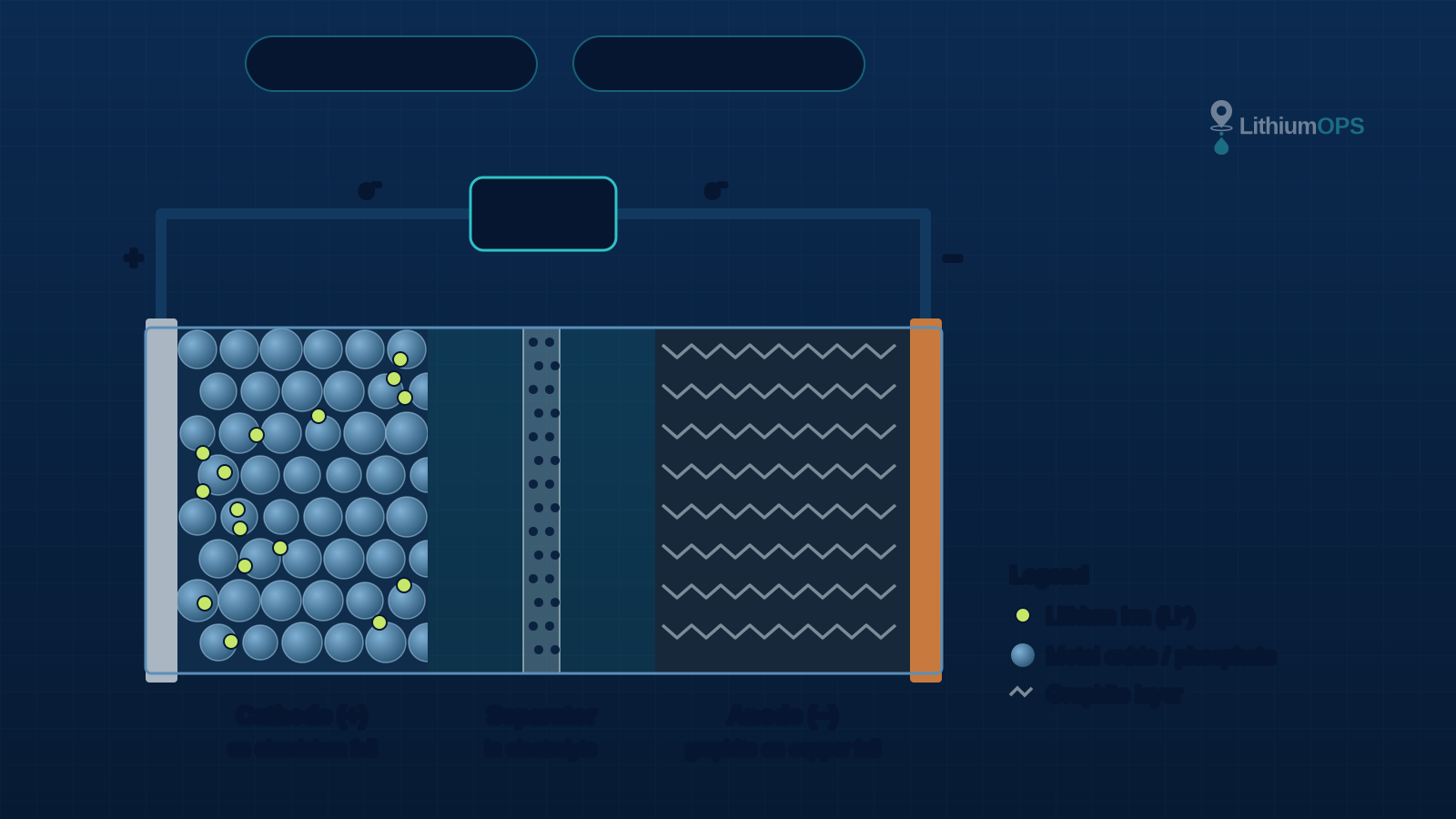
When the cell charges, lithium ions leave the cathode, cross the separator and settle between the graphite layers of the anode, while the charger pushes electrons the same way through the outside wire. When it discharges, the ions go back to the cathode and the electrons flow through the device, which is what powers it. The lithium is not used up; it moves back and forth on every cycle.
Most of the lithium in a cell sits in the cathode, and the cathode also decides much of the cell's energy, safety, life and cost. That is why the choice of cathode chemistry drives demand for lithium carbonate or lithium hydroxide.
Comparing Cathode Chemistries
Several cathode chemistries are in use today. They all store lithium, but pair it with different metals: cobalt, manganese, nickel, aluminium or iron. No chemistry wins on every count. The charts below compare the five main lithium-ion cathodes, plus sodium-ion for reference, on energy (how much a cell stores per kilogram), power (how fast it can charge and discharge), safety, life span and cost. The further a point sits from the centre, the better the chemistry scores.
Scale from 1 (low) to 4 (very high). For cost, a higher score means cheaper. Lithium-ion ratings adapted from Battery University (BU-205); sodium-ion is an indicative estimate. They compare typical cells, and a given product can differ.
| Chemistry | Energy (Wh/kg) | Voltage (V) | Cycle life | Thermal runaway | Lithium salt |
|---|---|---|---|---|---|
| LCO | 150–200 | 3.6 | 500–1,000 | ≈150 °C | Li₂CO₃ |
| LMO | 100–150 | 3.7 | 300–700 | ≈250 °C | Li₂CO₃ |
| NMC | 150–270 | 3.6–3.7 | 1,000–2,000 | ≈210 °C | LiOH (high-Ni) · Li₂CO₃ |
| NCA | 200–260 | 3.6 | ≈500–1,000 | ≈150 °C | LiOH |
| LFP | ≈160–205 | 3.2 | 2,000–6,000+ | ≈270 °C | Li₂CO₃ |
| Na-ion | ≈100–175 | ≈3.0–3.2 | varies by design | low risk | none (sodium salts) |
Sodium-ion works like lithium-ion, with sodium ions moving between the electrodes instead of lithium. The cathode is a sodium layered oxide, a Prussian blue compound or a sodium phosphate, and the anode is hard carbon, because sodium does not fit into graphite. Both electrodes can use aluminium foil, so no copper is needed, and the cells can be made on lines similar to lithium-ion ones. Its raw materials, mainly soda ash, are cheap and found almost everywhere.
Is it disruptive? Only in part. It stores less energy than LFP and its manufacturing capacity is still around 1% of lithium-ion, so it is not replacing lithium in mainstream EVs. It competes where weight matters less, such as small cars, two-wheelers and grid storage. For lithium, its main effect is on price: when lithium is expensive, sodium-ion becomes an attractive alternative, which helps cap how high lithium prices can go.
Nickel-rich NMC and NCA store the most energy per kilogram, so long-range vehicles still use them. That keeps demand for hydroxide alive.
LFP uses no nickel or cobalt and takes the cheaper lithium salt. Its lower cost per kWh is the main reason for the shift in the market.
LFP lasts more cycles and is much harder to push into thermal runaway. That suits grid storage and heavy fleets as well as cheaper cars.
Hydroxide can be made from carbonate with lime or straight from spodumene. The product a project chooses tells you which customer it is aiming at.
Two Salts, Two Customers
Everything upstream (salars, hard rock, ponds, DLE and the chemical plants) ends in one of two products: lithium carbonate (Li₂CO₃) or lithium hydroxide monohydrate (LiOH·H₂O). They can't simply replace each other, and the main reason is their melting point.
A lithium salt reacts well once it melts and spreads over the precursor. Carbonate only melts at about 720 °C, so a cathode made with it has to be fired hot. A nickel-rich cathode can't take that heat: its layered structure becomes disordered and it loses capacity. Hydroxide melts at about 462 °C, well inside the safe range, so high-nickel cathodes are built around it.
Why Ni-rich NMC and NCA Need Hydroxide
The melting point has two practical effects. Molten hydroxide covers the precursor evenly, so lithium reaches the whole particle instead of reacting only from the outside, and less unreacted salt stays on the surface. And because the blend has no carbonate in it, the firing does not release CO and CO₂ into the furnace while the crystal is forming.
The difference shows up in the finished cell. Cathodes made with hydroxide have been reported to keep around 91% of their capacity after 400 cycles, against 86% for the carbonate route. Hydroxide has drawbacks: it is more corrosive to handle, and its purity varies more from batch to batch. For nickel-rich material, though, there is no real alternative. As a rough guide, Ni-rich NMC or NCA cells need about 780 tonnes of LiOH per GWh.
Why LFP Uses Carbonate
Lithium iron phosphate has no nickel to protect. Its olivine structure is fired under nitrogen at temperatures carbonate handles easily, so it doesn't need hydroxide's low melting point. LFP therefore uses the cheaper, more stable and less corrosive salt. That one technical fact links the choice of battery chemistry to the economics of lithium projects.
The market has moved quickly. LFP made up over 55% of EV batteries deployed worldwide in 2025, up from nearly 50% in 2024, helped by packs that cost more than 40% less per kWh than NMC. Each point of share LFP gains shifts demand from hydroxide to carbonate.
What This Means When Reading a Project
When a developer states its end product, it is also naming its customer. Carbonate points to LFP and the high-volume end of the market; hydroxide points to nickel-rich cells and long-range vehicles. Neither is better by default, but they are priced separately, sold under different contracts and depend on different parts of battery demand. That is why the product a project plans to sell matters as much as the size of its resource when comparing two projects.
From Lithium Salt to Cathode Material
Cathode plants turn LC or LHM into cathode active material (CAM) in four main steps. The lithium salt only enters at step 2, and step 3 is where the choice of salt matters most.
The cathode starts without any lithium in it. For NMC and NCA, nickel, manganese, cobalt or aluminium sulfates are co-precipitated in a stirred reactor into a mixed hydroxide with a controlled particle shape. For LFP, the precursor is iron phosphate. The size, density and porosity of the final particle are mostly set here.
The precursor is blended with the lithium salt at a tightly controlled ratio: LiOH for nickel-rich NMC and NCA, Li₂CO₃ for LFP and lower-nickel NMC. LFP blends also get a carbon source, which ends up as a thin conductive coating. Too little lithium leaves gaps in the crystal, and too much leaves unreacted salt on the surface. This is also where impurities from the lithium plant start to turn into defects.
The blend is fired in a long kiln so the lithium diffuses into the crystal. NMC and NCA are fired in air or pure oxygen. Nickel-rich grades have to stay cooler: NCM811 below about 800 °C and NCM90 near 740 °C, while ordinary NMC made with carbonate needs 900 °C or more. LFP is fired under nitrogen, so the iron does not oxidise. This temperature window is the reason there are two lithium salts on the market.
The fired material is crushed and sieved to the target particle size. Nickel-rich powder is also washed to remove leftover lithium from the surface and then coated, because that surface lithium reacts with air and electrolyte and makes the cell produce gas. What leaves this step is cathode active material (CAM), ready for the cell maker.
Why the Plant's Certificate Matters Here
The impurity limits on a specification sheet can look arbitrary, but each one matters in this furnace. Sodium takes lithium's place in the crystal and disorders the layered structure, and the effect is worse the more nickel there is. Iron dissolves at cathode voltages, moves to the anode and can grow dendrites. Moisture and leftover surface lithium make the cell produce gas. Particle size decides how densely the powder packs into the electrode.
From Cathode Material to Battery Cell
The cathode powder then goes to a cell factory. The cathode is coated onto aluminium foil and the anode onto copper foil, the two are separated by a thin porous film, and the cell is filled with electrolyte. The electrolyte is itself a lithium product: a lithium salt, usually LiPF₆, dissolved in organic solvents, although it uses far less lithium than the cathode.
- 1Cathode electrode
Cathode material, a binder and conductive carbon are mixed into a slurry, coated on aluminium foil, dried and pressed.
- 2Anode electrode
Graphite, sometimes with some silicon, is coated on copper foil the same way.
- 3Assembly
The electrodes are cut and stacked or wound with a separator into a cylindrical, prismatic or pouch cell.
- 4Electrolyte
The cell is filled with a lithium salt, usually LiPF₆, dissolved in organic solvents, and sealed.
- 5Formation & aging
The first slow charges build a protective layer on the anode. The cells are then stored and tested.
- 6Module & pack
Cells are grouped into modules and packs with cooling and a battery management system (BMS).
From this point on, lithium is counted in kilowatt-hours rather than tonnes.