How Salars Form
A salar is a high-altitude salt flat that sits above a reservoir of lithium-rich brine. How it forms explains where brine lithium can be found and how much of it there is.
What Is a Salar?
A salar (from Spanish, meaning "salt marsh" or "salt flat") is a dried-out endorheic lake — a basin with no outlet to the sea. When the water evaporates, it leaves behind thick crusts of salt and minerals, including lithium chloride (LiCl) dissolved in the subsurface brine.
The world's most productive salars sit on the Altiplano plateau in South America — the so-called Lithium Triangle — at elevations between 3,500 and 4,600 m above sea level in Chile, Argentina, and Bolivia.
Geological Origin — Millions of Years in the Making
Salars form through a combination of tectonic uplift, volcanic activity, and extreme aridity. The process begins when tectonic plates collide — in the case of South America, the subduction of the Nazca Plate beneath the South American Plate uplifted the Andes and created the enclosed Altiplano basin.
Lithium leaches from surrounding volcanic rocks (ignimbrites, rhyolites) as rainwater and snowmelt percolate through them. Rivers carry this lithium-rich water into the basin, where it has no escape. Over hundreds of thousands of years, evaporation concentrates lithium and other salts (sodium, potassium, magnesium) in the subsurface brine.
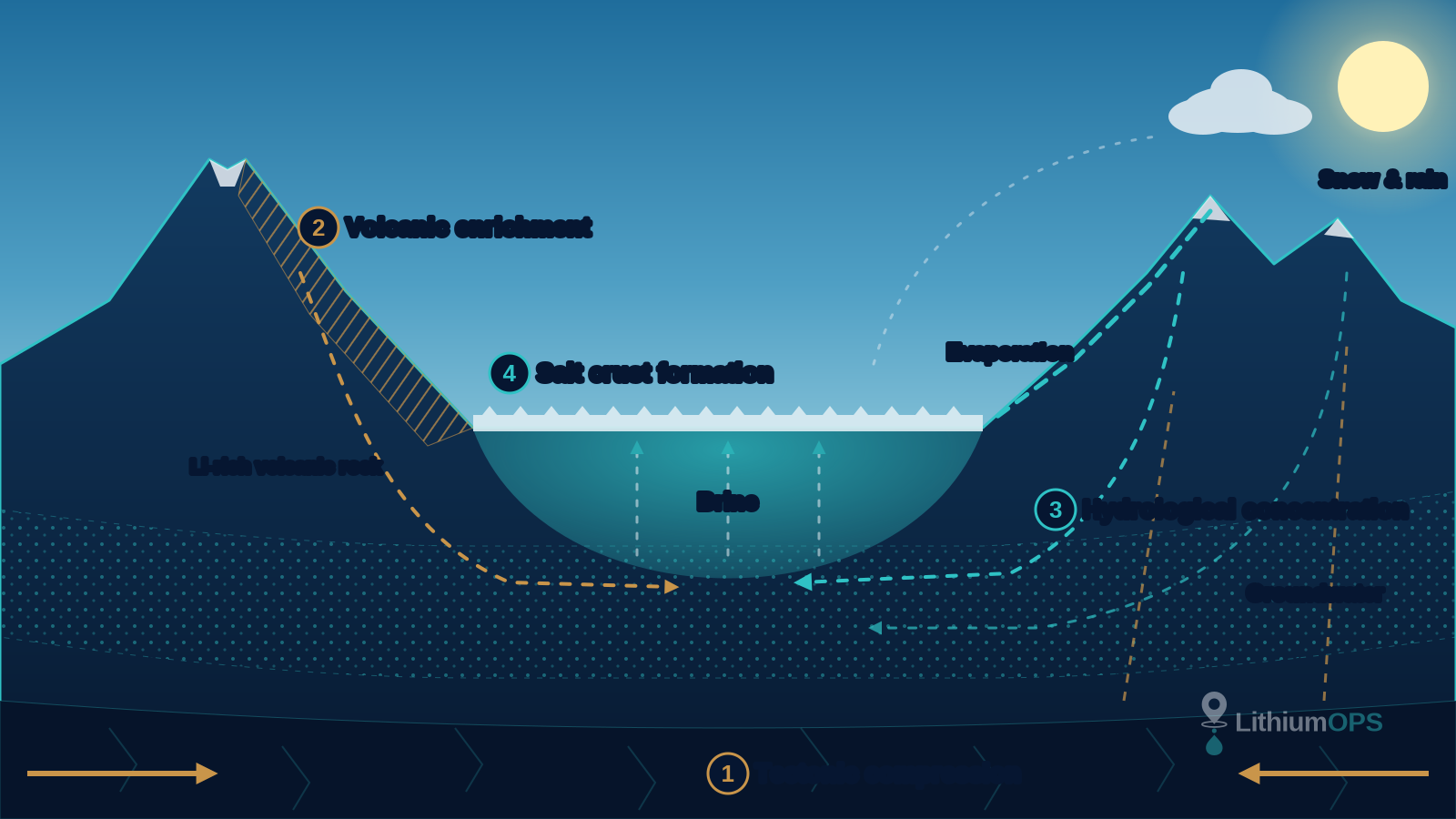
Plate collision uplifts the Andes, creating an enclosed basin with no outlet to the ocean. Water and minerals accumulate.
Volcanic eruptions deposit lithium-rich ignimbrites around the basin. Hydrothermal activity further concentrates lithium in subsurface aquifers.
Rivers and groundwater carry dissolved lithium into the basin. The extreme aridity (< 20 mm/year rainfall) causes rapid evaporation.
As water evaporates, less soluble salts (halite, gypsum) precipitate first, forming the surface crust. Lithium remains in the residual brine below.
Underground Brine Structure
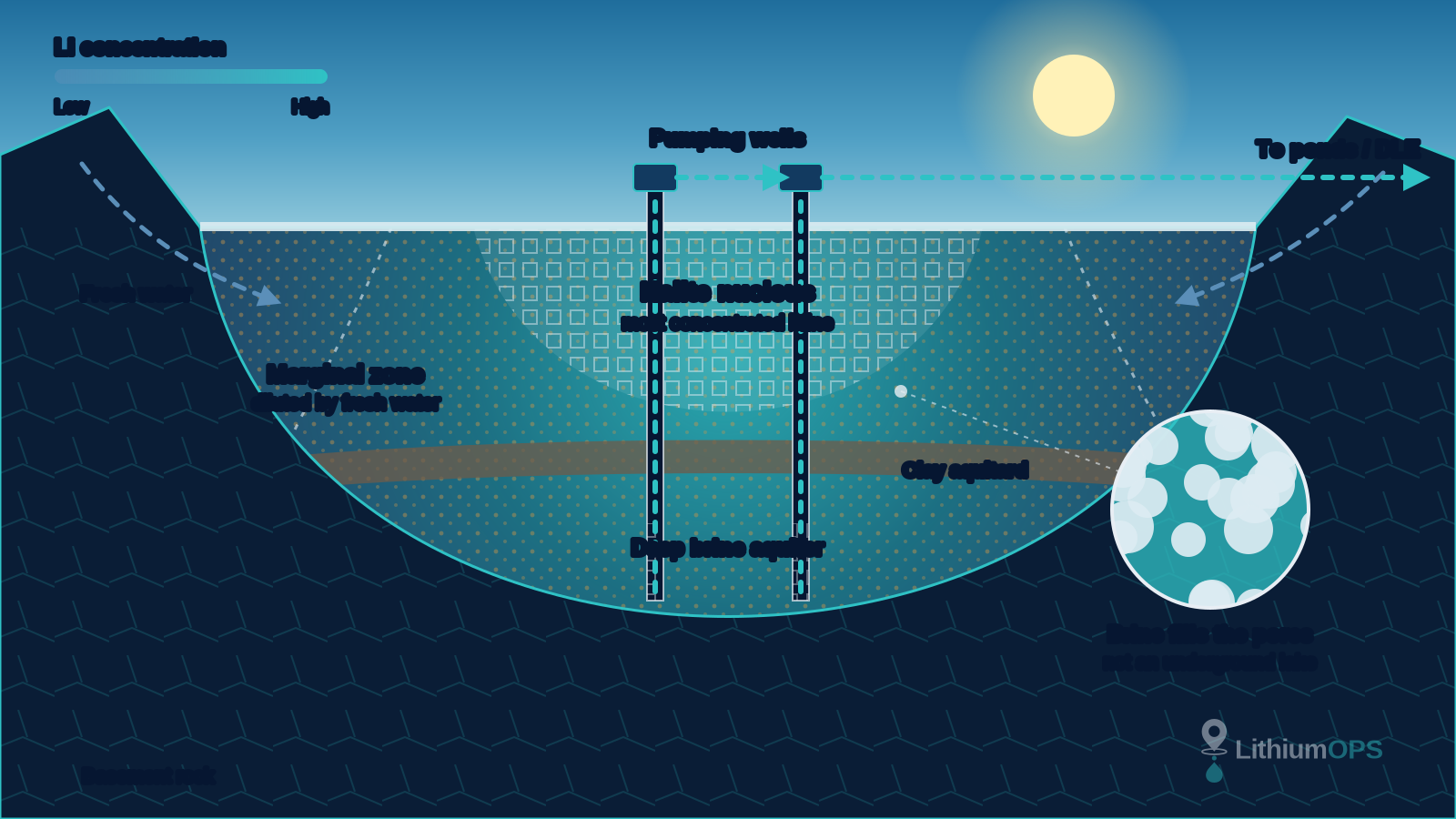
Below the salt crust lies a complex system of brine aquifers — porous zones saturated with saline water. These are not underground lakes but rather brine held within porous rock formations, similar to how oil sits in a reservoir.
The brine composition varies by depth and location within the salar. Typically the halite nucleus (centre of the salar) contains the most concentrated brine, while the margins contain more dilute solutions mixed with freshwater inputs.
Why Salar Geology Determines Project Value
Not all salars are equal. Every brine carries the same handful of elements — lithium (Li), sodium (Na), potassium (K), magnesium (Mg), calcium (Ca), boron (B), sulphate (SO₄) and chloride (Cl) — but in very different proportions. The economic value of a lithium brine deposit depends on three geological factors:
Higher lithium concentration means less brine needs to be pumped to produce the same amount of lithium. Atacama averages 1,400–1,800 mg/L; most other salars are below 600 mg/L.
The total brine resource depends on aquifer thickness, areal extent, and porosity. Measured in tonnes of lithium carbonate equivalent (LCE).
Magnesium is chemically similar to lithium and contaminates the product. A high Mg:Li ratio increases processing costs dramatically, sometimes making a project uneconomic.